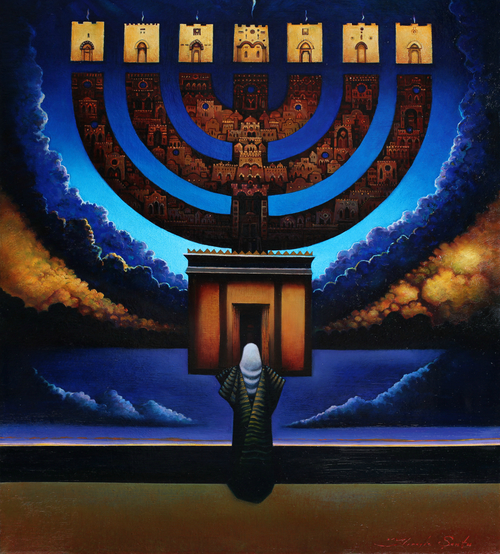
Visual arts in Israel

Visual arts in Israel refers to plastic art created in the Land of Israel/Palestine region, from the later part of the 19th century until today, or art created by Israeli artists. Visual art in Israel encompasses a wide spectrum of techniques, styles and themes reflecting a dialogue with Jewish art throughout the ages and attempts to formulate a national identity.[1]

Early art in the Land of Israel was mainly decorative art of a religious nature (primarily Jewish or Christian), produced for religious pilgrims, but also for export and local consumption. These objects included decorated tablets, embossed soaps, rubber stamps, etc., most of which were decorated with motifs from graphic arts.[2] In the Jewish settlements artists worked at gold smithing, silver smithing, and embroidery, producing their works in small crafts workshops. A portion of these works were intended to be amulets. One of the best known of these artists, Moshe Ben Yitzhak Mizrachi of Jerusalem made Shiviti (or Shivisi, in the Ashkenazic pronunciation, meditative plaques used in some Jewish communities for contemplation over God's name) on glass and amulets on parchments, with motifs such as the Sacrifice of Isaac, the Book of Esther, and views of the Temple Mount and the Western Wall.[3] Objects of applied art were produced also at the "Torah ve-Melakhah" ("Torah and Work") school founded in 1882 by the Alliance Israélite Universelle.[4] This school opened departments for the production of art objects in Neo-Classical and Baroque styles, produced by combining manual labor with modern machines.

A large body of artistic work was produced by European artists, primarily Christian painters, who came to document the sites and landscapes of the "Holy Land". The motive behind these works was orientalist and religious and focused on documentation – first of the painting and later of the photography – of the holy sites and the way of life in the Orient, and on the presentation of exotic people.[5] Photographs of the Holy Land, which also served as the basis for paintings, focused on documenting structures and people in full daylight, due to the limitations of photography at that time.[6] Therefore an ethnographic approach is in evidence in the photographs, which present a static and stereotypical image of the figures they depict. In the photographs of the French photographer Felix Bonfils such as, for example in his prominent photographs of the Holy Land in the last decades of the 19th century, we even see an artificial desert background, in front of which his figures are posed At the end of the 19th century and the beginning of the 20th century, local photographers began to appear, the most important of whom is Khalil Raad, who focused on an ethnographic description of the reality of the Holy Land, in large part colonialistic. In addition there were other photographers, many of them Armenian, who worked as commercial photographers in the Land of Israel and neighboring countries.

In the 1920s, many Jewish painters fleeing pogroms in Europe settled in Tel Aviv.[7]

History and Provenance of Szyk Haggadah Original Artwork

All forty-eight original watercolor and gouache paintings that appeared in Arthur Szyk’s Haggadah were completed between 1934 and 1936 in Łódź, Poland. He then took them to London in 1937 to supervise the printing of The Haggadah (1940) by the Sun Engraving Company (Beaconsfield Press, publisher). Szyk brought all the paintings to the United States when he immigrated to New York in late 1940. After the artist died in 1951, the family continued to hold the paintings until their private sale in 1980 to David Brass (E. Joseph Booksellers, London) and Warren Starr (New York). In June 1982, the artwork, all forty-eight paintings in one lot, were purchased at a Sotheby’s Judaica Auction (New York) by the Forest Group, LLC (Richard and Lois Janger, Chicago). The Jangers were marvelous caretakers of The Haggadah originals until their private sale to the Robbins Family (California) in 2006. 

The first edition (1) was printed on vellum by the Sun Engraving Company, London, 1940 and published by the Beaconsfield Press in a limited edition of 250 copies. All were numbered and signed by Arthur Szyk and Cecil Roth, translator and commentator. The first appearance of a popular edition on paper (2) took place in Israel in 1956, published in Jerusalem and Tel Aviv by Massadah and Magen. Ten thousand copies were printed, and another 10,000 were printed in 1957– all with blue velvet covers, and in a blue clamshell cloth box. Subsequent editions appeared in 1960, 1962, throughout the 1960’s and 1980’s up until 2003. These editions were printed in two sizes, some with velvet covers, embroidered covers, and metal covers (3) (even some with stone insets). Some were in cloth boxes, others in paper slipcases, some in paper boxes. All editions up until this point were printed from the same reproduction plates used in the 1940 edition.

In 2008, Historicana (Burlingame, California) published an entirely new edition from the original artwork, in Deluxe and Premier Editions (4), limited to 215 and 85 sets respectively. These editions featured an entirely new translation and commentary by Rabbi Byron L. Sherwin, Chicago, and a new design. A companion volume Freedom Illuminated: Understanding The Szyk Haggadah (edited by Byron Sherwin and Irvin Ungar) accompanied the limited edition sets, as well as a documentary movie entitled “In Every Generation, Remaking The Haggadah.” ( http://szyk. com/szyk-haggadah/documentary-film. htm?mnHd=1&mnSubHd=9 ) The movie was directed by Jim Ruxin, Los Angeles.

In 2011, Abrams Books (New York) published a new popular, usable edition of The Szyk Haggadah (5), created by Irvin Ungar and featuring Rabbi Sherwin’s commentary based upon the 2008 Historicana editions. The Abrams edition added more instructions for using Szyk’s Haggadah, added contemporary rituals in the Commentary Section that have evolved in Passover ceremonies since the 1940 publication, and included transliteration of key readings and songs. It was published in both softcover and hardcover gift editions. 

Source: www.szyk.com

Israeli Art

Part of what makes the art scene in Israel so unique is that the country blends so many varying influences from all over the Jewish world.

BY MJL STAFF

Mark Shagal.jpg

Though the modern State of Israel has officially been independent only since 1948, its unique blend of dynamic arts and different cultural traditions has been around for some time longer. Part of what makes the art scene in Israel so unique is that the country blends so many varying influences from all over the Jewish world. In the case of folk arts, for example, a wide range of crafts can be found flourishing–from Yemenite-style jewelry making to the embroidery and other needle crafts of the Eastern European Jews. Over the last half-century, as artisans have mixed and mingled and learned from one another, a certain “Israeli” style of folk art has emerged, reflecting all of the cultures who make up the modern state.

In the fine arts, there has also been a desire to create an “Israeli” art. From the late 19th and early 20th centuries, when significant numbers of Jews began fleeing Europe and settling in the Land of Israel with Zionistic dreams, the fine arts have occupied a prominent place in Israeli life. Artist Boris Schatz came to Jerusalem in order to establish the Bezalel School–named for the Biblical figure chosen by God to create the first tabernacle. A university-level academy known today as the Bezalel Academy of Art and Design, the flourishing of the school typifies the country’s support of its artists.

Unlike the United States, where the virtue of public art continues to be debated, the Israeli government makes clear its support of visual artists and their contributions to society. In Israel, the role of public art helps to express and define the concerns of a common, yet diverse, culture. In a country that struggles daily to protect its inhabitants, art is considered to be a necessity, rather than a luxury. Perhaps it is the distinct Israeli-style “live for today” philosophy that makes the appreciation of art more vivid than in other, “safer” countries.

Not that Israel’s artists have always had an easy time defining themselves in relation to the rest of the art world. Early Israeli painters like Nahum Gutman tried to create a unique “Hebrew” style of art–capturing the excitement of establishing a Zionist state–while maintaining his influences from Modern European art. Other great Israeli artists such as Reuven Rubin had to leave Israel for periods of their life in order to receive the recognition that they desired; Rubin’s first major exhibit was held in the United States, thanks to his friend, the photographer Alfred Stieglitz.

Not all successful Israeli artists have portrayed Jewish or Zionist themes in their work. One of Israel’s best-known artists, for example, Yaacov Agam, is known for his unique expression of optical art. Indeed, as life in Israel became more established, the diversity of Israeli artists increased. As Israeli artists became accepted into the international art scene, their work took on the various styles and aesthetic approaches reflected in the wider art world.

Just as the politics of two Israelis can be as far apart on the spectrum as imaginable, so are the political ideologies of its artists, whose works might include everything from anti-war statements to paintings of national pride. Israeli art has matured to express the range of opinions and emotions circling in Israeli life; therefore, there is no one style, ideology or medium that defines an Israeli artist today.

But what each Israeli artist has in common is that they are fortunate to come from a culture that values the work of artists and continues to support creation of the arts as an integral part of its unique social fabric.

©  Faces Media